
Key Features
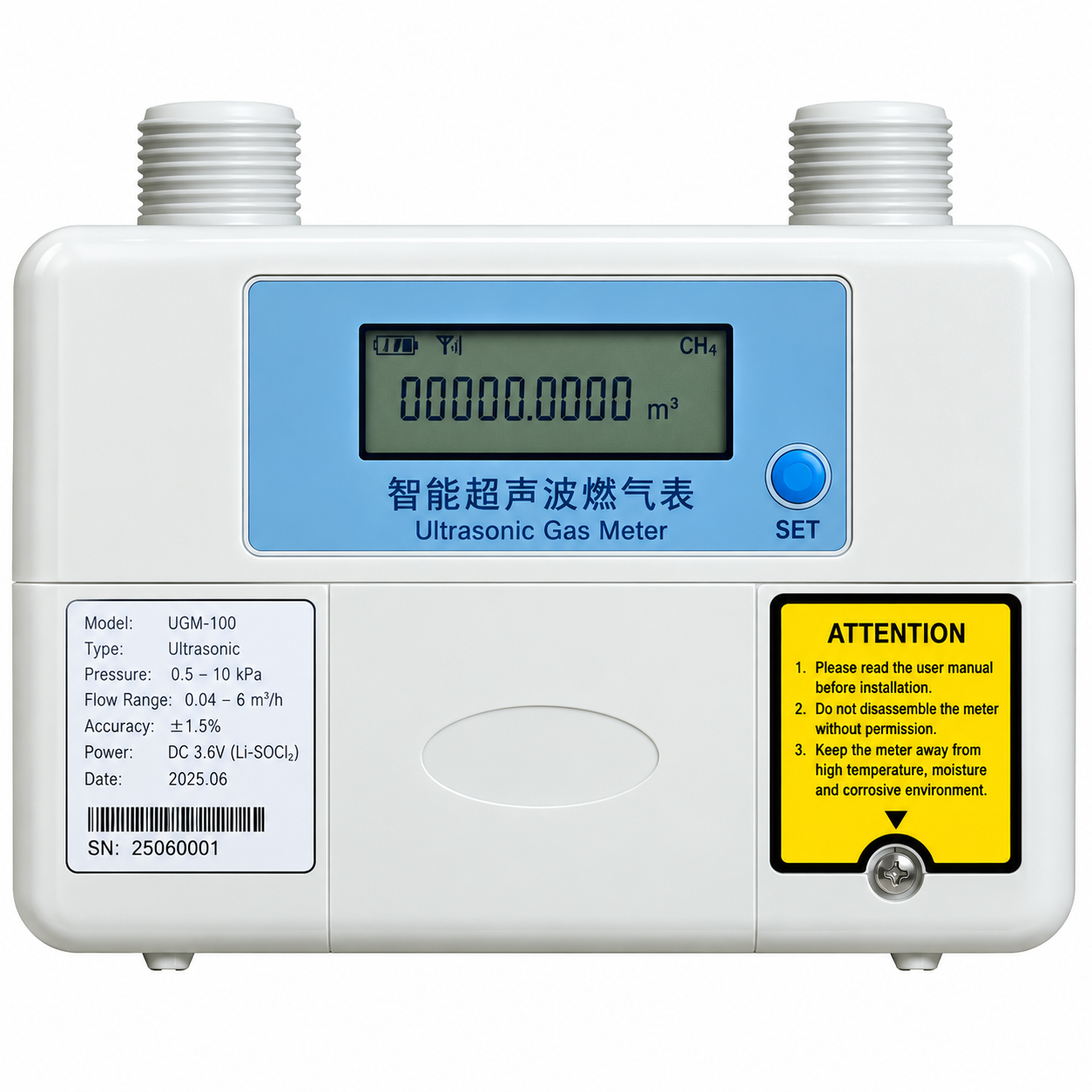
- Ultrasonic transit-time measurement technology
- Accurate real-time biogas flow measurement
- Measures instantaneous flow rate and cumulative gas volume
- No moving mechanical parts
- Low maintenance and long service life
- Minimal pressure loss
- Suitable for wet and variable-composition biogas
- Resistant to common biogas components such as CO₂ and H₂S, depending on model
- High measurement repeatability
- Digital display for easy monitoring
- Temperature compensation available on selected models
- Pressure compensation available on selected models
- Optional methane (CH₄) measurement on selected models
- RS-485/Modbus communication available on selected models
- Compatible with data loggers, PLCs and IoT monitoring systems
- Suitable for biogas production and consumption monitoring
- Available in different pipe sizes and flow ranges
- Suitable for agricultural, commercial, institutional and industrial biogas systems
- Hazardous-area/Ex-certified versions available for suitable applications
Functions
- Measures real-time biogas flow rate
- Measures total/cumulative biogas volume
- Monitors biogas production from digesters
- Monitors biogas consumption by appliances and generators
- Records and tracks daily, weekly and monthly gas usage
- Detects changes in biogas production and consumption
- Measures gas temperature on selected models
- Measures or compensates for gas pressure on selected models
- Calculates corrected/standard gas volume on compatible models
- Measures methane (CH₄) concentration on selected models
- Provides digital flow data for monitoring and control systems
- Communicates with PLCs, data loggers and IoT gateways through available interfaces such as RS-485/Modbus
- Supports biogas plant performance monitoring and energy management
- Helps identify abnormal gas production, consumption or possible leakage
- Provides data for evaluating digester efficiency and biogas utilization
Benefits
- Accurate gas measurement – Provides reliable measurement of biogas flow and total gas volume.
- No moving parts – Reduces mechanical wear, breakdowns and maintenance requirements.
- Low maintenance – Requires less routine maintenance compared with many mechanical flow meters.
- Minimal pressure loss – Helps maintain available biogas pressure within the pipeline.
- Suitable for wet biogas – Specialized models can measure biogas containing moisture and condensate.
- Improved digester monitoring – Helps track biogas production and identify changes in digester performance.
- Better gas consumption management – Shows how much biogas is being used by appliances, boilers or generators.
- Supports energy management – Helps determine the amount of biogas available for cooking, heating and electricity generation.
- Real-time monitoring – Provides immediate information about gas flow and usage.
- Digital connectivity – Compatible models can transmit data to monitoring systems, PLCs, data loggers and IoT gateways.
- Long service life – Non-mechanical measurement technology can provide dependable operation over extended periods.
- Reduced operating costs – Accurate monitoring helps minimize gas wastage and improve system efficiency.
- Early detection of problems – Unexpected changes in flow can help identify leaks, blockages or abnormal system operation.
- Scalable solution – Suitable for household, agricultural, institutional, commercial and industrial biogas installations.
- Supports data-driven biogas management – Historical flow data can be used to analyze production, consumption and overall plant performance.
Typical Applications
- Biogas digesters – Monitoring gas production from anaerobic digesters.
- Farm biogas plants – Measuring biogas generated from animal manure and agricultural waste.
- Household biogas systems – Monitoring gas production and household consumption.
- Institutional biogas plants – Schools, hospitals, prisons, hotels and other large facilities.
- Commercial biogas plants – Monitoring gas production and distribution.
- Food-waste digesters – Measuring biogas generated from organic food waste.
- Wastewater treatment plants – Monitoring digester gas production.
- Sewage treatment plants – Measuring biogas generated during sewage digestion.
- Industrial biogas systems – Monitoring gas production and consumption in industrial processes.
- Biogas generators – Measuring gas supplied to engines and generators.
- Combined Heat and Power (CHP) systems – Monitoring fuel-gas consumption and energy production.
- Biogas boilers and burners – Measuring gas consumption for heating applications.
- Biogas upgrading systems – Monitoring gas flow before or after upgrading.
- Gas storage systems – Measuring gas entering and leaving gas storage units.
- Biogas distribution pipelines – Monitoring gas flow between different sections of a biogas system.
- Gas flaring systems – Measuring the quantity of biogas sent to a flare.
- Biogas monitoring and IoT systems – Providing flow data to digital monitoring, data logging and remote-control platforms.
- Research and pilot projects – Measuring biogas production and performance during testing and research.
How an Ultrasonic Biogas Flow Meter Works
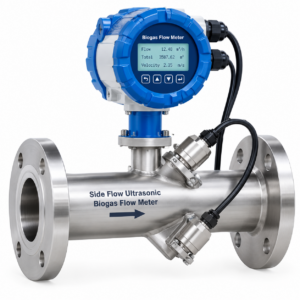
An ultrasonic biogas flow meter measures gas flow using ultrasonic sound waves rather than mechanical moving parts.
- Ultrasonic signals are transmitted
Sensors inside the meter send ultrasonic signals through the biogas pipeline, both with and against the direction of gas flow.
- Travel time is measured
The meter measures how long each ultrasonic signal takes to travel between the sensors.
- Gas velocity is calculated
When biogas is flowing, the signal travelling with the gas moves slightly faster than the signal travelling against the gas. The difference in travel time is used to calculate the velocity of the biogas.
- Flow rate is determined
The meter combines the calculated gas velocity with the internal pipe diameter/cross-sectional area to determine the volumetric flow rate.
- Total gas volume is calculated
The meter continuously adds the measured flow to provide the cumulative volume of biogas that has passed through the pipeline.
- Temperature and pressure compensation
Advanced models can measure or receive temperature and pressure data to calculate corrected or standard gas volumes.
- Digital data output
Depending on the model, measurements can be displayed locally or transmitted through interfaces such as RS-485/Modbus, pulse or 4–20 mA to a monitoring system, data logger or IoT gateway.
In simple terms:
Ultrasonic signals → Measure travel-time difference → Calculate gas velocity → Calculate flow rate → Totalize gas volume
Because the measurement does not depend on a rotating turbine or impeller, ultrasonic flow meters can provide low-maintenance, continuous biogas measurement with minimal pressure loss.
Reviews
There are no reviews yet.