
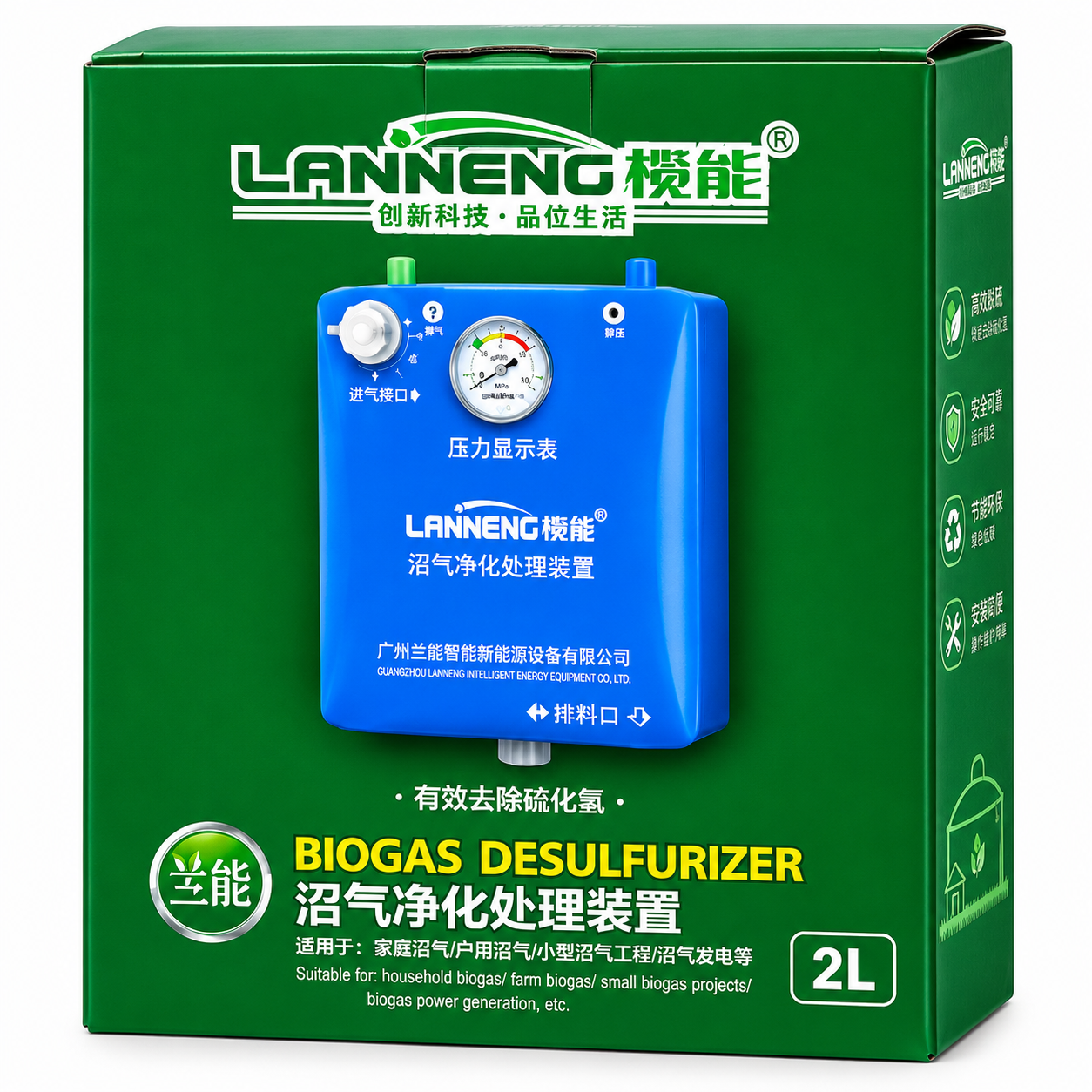

Key Features
- Designed for domestic biogas purification.
- Reduces hydrogen sulphide (H₂S) in biogas.
- Available in compact designs for household biogas systems.
- Uses replaceable or regenerable desulphurisation media, depending on the model.
- Helps protect gas pipes, burners, cookers, and other connected equipment from corrosion.
- Available in different media capacities and gas-flow ratings.
- Designed for installation in suitable biogas pipeline systems.
- Simple inspection and maintenance requirements, depending on the model.
Functions
- Removes or reduces hydrogen sulphide from raw biogas.
- Helps reduce corrosion in gas pipelines and connected equipment.
- Improves the quality of biogas supplied to domestic appliances.
- Helps protect gas burners, cookers, heaters, and generators from sulphur-related damage.
- Supports routine gas cleaning before biogas utilisation.
Benefits
- Equipment Protection: Helps minimise hydrogen-sulphide-related corrosion.
- Improved Gas Quality: Reduces an undesirable contaminant in raw biogas.
- Reduced Maintenance: May lower maintenance needs caused by sulphur compounds.
- Longer Equipment Life: Helps protect compatible appliances and pipeline components.
- Domestic Convenience: Provides a practical gas-treatment option for household biodigesters.
- Flexible Installation: Can be incorporated into appropriately designed domestic biogas systems.
- Improved Safety: Reduces H₂S exposure risk when correctly sized, installed, and maintained, although it does not eliminate all biogas hazards.
Typical Applications
- Household biogas digesters.
- Domestic biogas cooking systems.
- Small farm biogas installations.
- Biogas-powered water heaters.
- Small biogas generators, where the treatment capacity meets the manufacturer’s requirements.
- Other small-scale anaerobic digestion systems.
Installation and Maintenance
- Install the unit in the correct position and direction of gas flow as specified by the manufacturer.
- Confirm that the unit’s operating pressure and flow capacity match the biogas system.
- Inspect the desulphurisation media regularly and replace or regenerate it as recommended.
- Check all joints and connections for gas leaks.
- Keep the unit protected from excessive moisture unless it is designed for wet-gas operation.
- Handle spent media according to the manufacturer’s instructions and applicable waste-management requirements.
- Never use an open flame to check for gas leaks.
- Ensure good ventilation and observe appropriate methane and hydrogen sulphide safety precautions.
Important Product Information
Desulphuriser performance depends on the incoming H₂S concentration, gas flow rate, moisture level, media type, and media quantity. The unit’s media eventually becomes exhausted and requires replacement or regeneration where permitted.
A biogas desulphuriser primarily targets hydrogen sulphide; it does not necessarily remove water vapour, carbon dioxide, or other contaminants. A separate biogas dehydrator may be required for moisture removal.

Reviews
There are no reviews yet.