
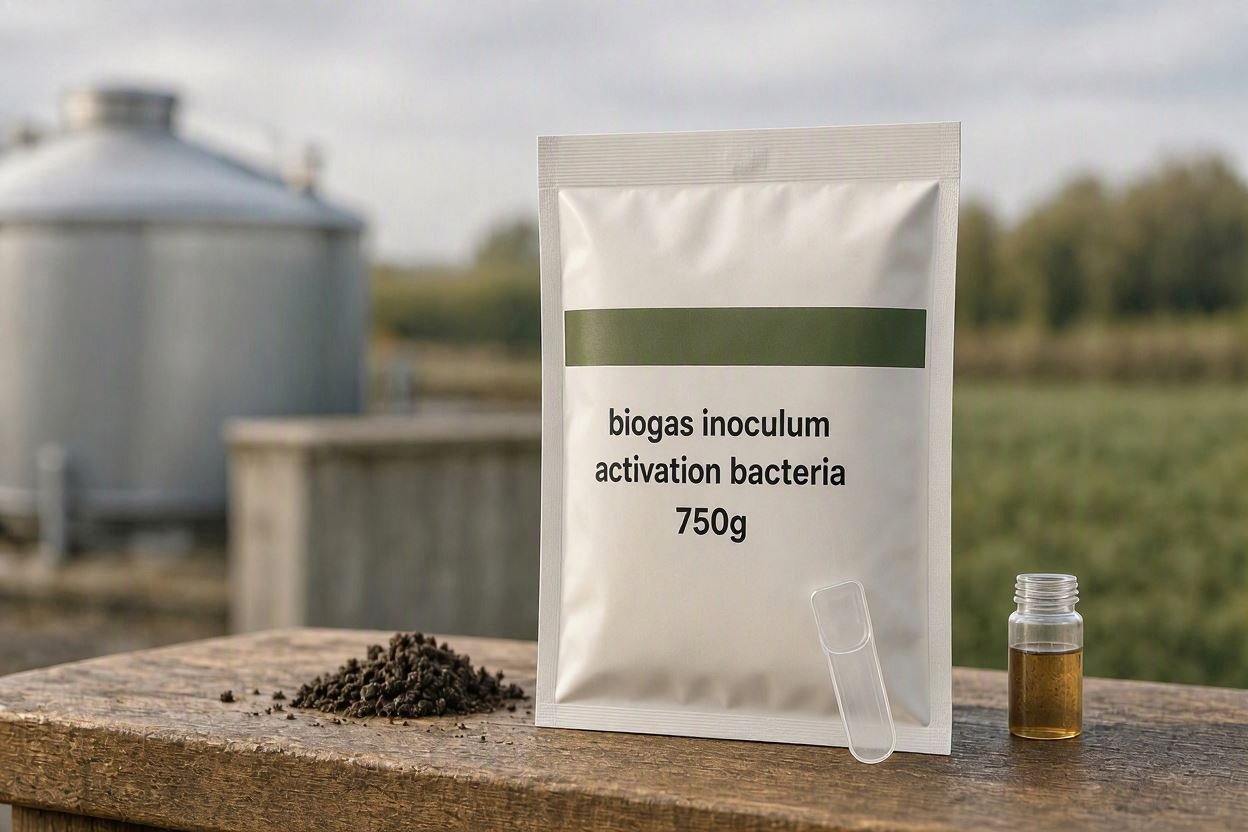
Key Features
- Contains beneficial anaerobic microorganisms.
- Supports biological decomposition of organic waste.
- Helps establish and maintain active digestion.
- Suitable for different types of biogas digesters.
- Can assist during initial digester start-up.
- Helps improve digestion of biodegradable feedstock.
- Easy to apply according to manufacturer instructions.
- Suitable for agricultural, household, institutional and commercial biogas systems.
- Can support stable biological activity when feedstock conditions change.
Functions
- Initiates and supports anaerobic fermentation.
- Breaks down organic matter inside the digester.
- Supports conversion of organic waste into biogas.
- Helps maintain microbial activity.
- Supports methane-producing microorganisms.
- Can help improve digestion efficiency.
- Assists in restarting or strengthening biological activity in an underperforming digester.
Benefits
- Helps promote faster digester start-up.
- Supports consistent biogas production.
- Improves organic waste decomposition.
- Can reduce the time required to establish active digestion.
- Supports efficient utilization of manure and organic waste.
- Helps maintain healthy microbial activity.
- May improve digester performance when biological activity is low.
- Supports production of useful nutrient-rich digestate.
- Reduces dependence on slow natural microbial establishment during commissioning.
Typical Applications
- Household biogas digesters.
- Dairy and cattle manure digesters.
- Pig and poultry waste digesters.
- Food-waste biogas plants.
- Agricultural waste digesters.
- Institutional biogas systems.
- Commercial and industrial anaerobic digesters.
- New digester commissioning.
- Digester recovery or restart.
- Systems experiencing reduced biological activity.
How It Works
Biogas fermentation bacteria work within the anaerobic environment of the digester. The microorganisms participate in the biological stages of anaerobic digestion, breaking complex organic materials into simpler compounds that are eventually converted into methane-rich biogas.
The bacteria are introduced into the digester together with suitable feedstock or water, following the recommended dosage and application procedure. Once established, the microbial population continues to reproduce and participate in the digestion process as long as suitable conditions are maintained.
Important Considerations
For effective performance, the digester should maintain suitable conditions such as appropriate temperature, pH, moisture content, organic loading and retention time. Excessive chemicals, antibiotics, disinfectants or other substances that inhibit anaerobic microorganisms should be avoided.
Reviews
There are no reviews yet.