
Benefits
1. Uses Renewable Biogas
The stove allows customers to convert biogas produced from organic waste into useful cooking energy. This can help households and farms make productive use of livestock manure, food waste and other suitable organic feedstocks.
2. Reduces Dependence on Conventional Cooking Fuels
Where sufficient biogas is available, the stove can provide an alternative cooking-energy source alongside or instead of fuels such as firewood, charcoal or LPG.
3. Cleaner Cooking Environment
Biogas combustion does not produce the smoke and ash associated with traditional solid biomass combustion. Properly designed and operated biogas burners can also achieve relatively clean combustion. Research on biogas burners has demonstrated substantial differences in CO and NOx emissions depending on burner design and operating conditions.
4. Convenient Flame Control
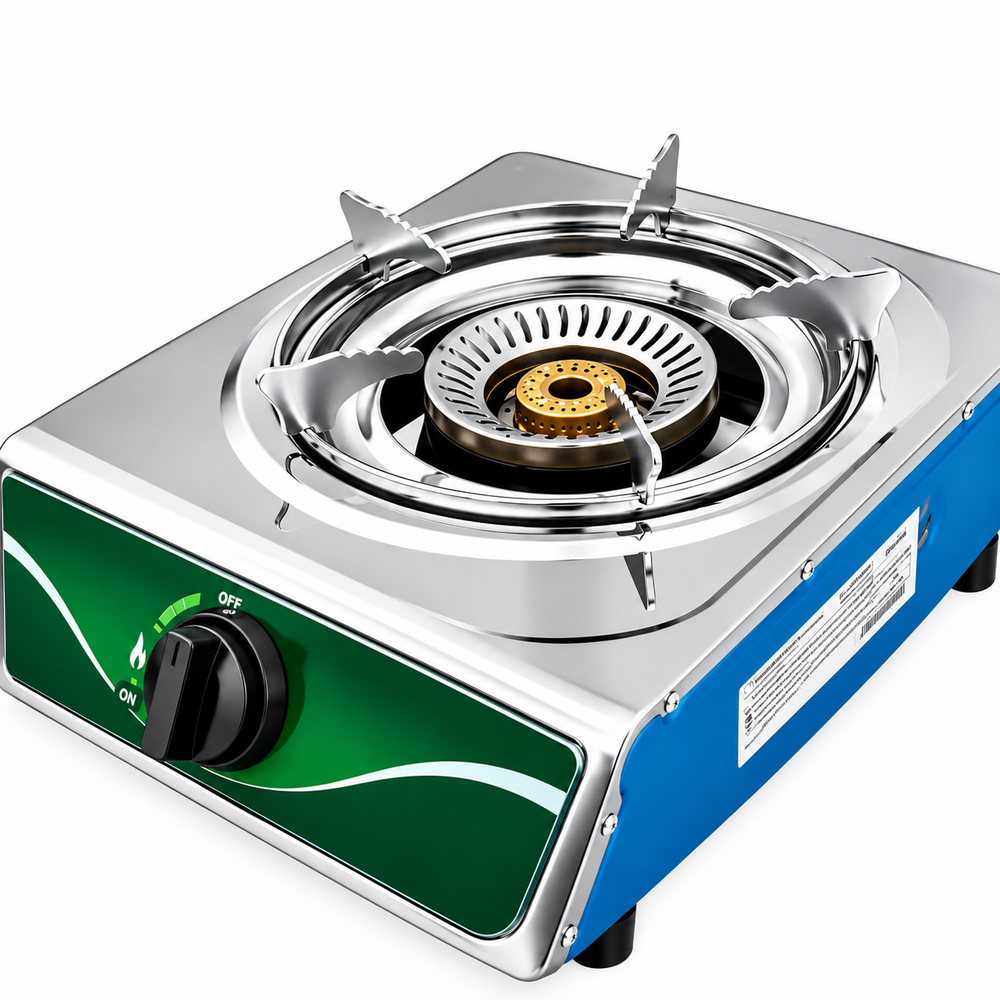
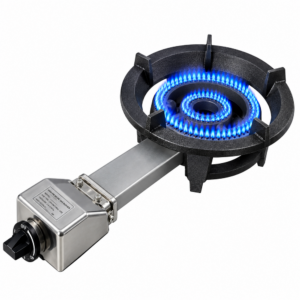
The control knob allows the user to increase or reduce the flame according to the cooking task, making it possible to use higher heat for boiling and lower heat for simmering.
5. Easy to Clean
The smooth metal cooking surface can be wiped down after cooking, while removable or accessible pot-support components can make routine cleaning easier.
6. Compact Design
Its single-burner configuration is useful where kitchen space is limited or where an additional cooking point is required.
7. Turns Waste into Useful Energy
When connected to a biodigester, the appliance forms part of a waste-to-energy system:
Organic Waste → Biodigester → Biogas → Gas Cleaning → Biogas Stove → Cooking Energy
Recommended Applications
The stove can be suitable for:
- Residential homes
- Farms
- Dairy farms
- Poultry farms
- Pig farms
- Restaurants and small food businesses
- Eco-lodges
- Schools and institutions
- Community biogas projects
- Demonstration and training centres
- Kitchens with household or farm-scale biodigesters
- Backup or supplementary cooking systems
How It Works
- Organic waste is fed into a biogas digester.
- Microorganisms break down the organic material through anaerobic digestion.
- The process produces biogas containing methane and other gases.
- The biogas passes through appropriate moisture and hydrogen-sulphide treatment equipment, where required.
- Conditioned biogas travels through the gas pipeline to the kitchen.
- The user opens the stove’s gas control.
- Biogas mixes with air and burns at the burner ports.
- The resulting flame provides heat for cooking
Important Installation Information
For reliable operation, the stove should be connected to a properly designed biogas distribution system.
The installation should consider:
- Biogas pressure at the appliance
- Gas-pipe diameter and length
- Gas-flow capacity
- Moisture in the gas line
- Hydrogen sulphide removal
- Gas leakage prevention
- Adequate kitchen ventilation
- Correct burner jet/nozzle configuration
- Correct distance between burner and cookware
Safety
For safe operation:
- Install the appliance according to the manufacturer’s instructions.
- Check all gas connections for leakage before use.
- Never use a damaged gas hose or connector.
- Keep combustible materials away from the burner.
- Ensure adequate ventilation in the cooking area.
- Do not modify the burner jet/nozzle without technical guidance.
- Keep children away from the operating appliance.
- Shut off the gas supply when the stove is not in use.
- If the flame repeatedly goes out, investigate gas pressure, gas quality, burner condition and ventilation rather than continuing to operate the appliance.
Maintenance
Routine maintenance should include:
- Cleaning the burner ports.
- Removing food deposits and grease from the cooking surface.
- Inspecting the gas hose and connections.
- Checking the control valve.
- Checking pot supports for damage or deformation.
- Inspecting the burner for corrosion or blockage.
- Checking for unusual flame colour or unstable flames.
- Periodically inspecting the complete gas line and gas-treatment equipment.
Reviews
There are no reviews yet.